 Next working day delivery by
 CALL US
 Monday to Friday

It is just frozen cream and sugar. And yet, across more than a century of fiction, poetry and film, ice cream has carried the weight of longing, joy, heartbreak, freedom and mortality. From a poet pondering death at a wake to a princess abandoning royal decorum on the Spanish Steps, writers and filmmakers keep reaching for the same cold, sweet prop.
There is something about ice cream that resists being merely a dessert. It melts. It is sweet but temporary. It belongs to childhood but comforts adults.
Storytellers understand all of this instinctively, which is precisely why a single scoop can do the work of a thousand words.
Why Ice Cream Works as a Symbol
In storytelling, physical objects carry emotional weight that dialogue often cannot. Ice cream sits at a rare intersection of meanings: childhood innocence, fleeting happiness, comfort, rebellion against propriety and the bittersweet knowledge that good things do not last. Its physical property of melting is a feature, not a flaw, joy that cannot last is still worth having.
When ice cream appears in a novel or on screen, it is rarely accidental. It is doing something.
Ice Cream in Poetry and Literature
Wallace Stevens and the Emperor Who Rules Everything
In 1922, Wallace Stevens published “The Emperor of Ice-Cream,” and literary scholars have been arguing about it ever since. The poem takes place at a wake: while a dead woman’s body lies in the next room, young people in the kitchen whip up ice cream, bring flowers in yesterday’s newspaper and carry on with the business of living.
The refrain, “The only emperor is the emperor of ice-cream” lands like a philosophical manifesto. Stevens argues that the sensory present is the only real authority over our lives. Death is there in the next room, cold and undeniable, but life insists on continuing, and it insists on ice cream. The most mundane of pleasures is elevated to the status of an emperor, and the grand and solemn yield to the simple and sweet.
Any time a film places a tub of Ben & Jerry’s next to a grieving character, there is an echo of Stevens in it.
Shel Silverstein’s Eighteen Flavours of Tragedy
Shel Silverstein was a genius at disguising genuine feeling behind absurdist comedy. “Eighteen Flavours,” from Where the Sidewalk Ends, lists eighteen ice cream flavours with increasing enthusiasm before delivering its punchline: the entire magnificent tower of scoops is lying on the ground.
It is funny. It is also faintly devastating, the sudden end of something perfect. For a child, a dropped ice cream cone is not trivial. Every flavour listed builds the anticipation; every flavour lost deepens the small catastrophe.
The poem also hits differently at forty than it does at eight, which is the mark of writing that genuinely lasts.
Roald Dahl’s Ice Cream That Would Not Melt
Roald Dahl gives ice cream two appearances in Charlie and the Chocolate Factory. The rival sweet-maker Fickelgruber steals Wonka’s recipe for ice cream that never melts, a fantastical innovation that drives the whole backstory of Wonka’s paranoia. Later, Wonka reveals “Hot Ice Creams for Cold Days.”
Both examples do what Dahl always does: take the familiar and make it strange enough to reveal the familiar’s true oddness. Ice cream that never melts is alarming, not delightful. The perfection of ice cream, its sweetness, its softness, its temporariness, depends on it melting. Dahl understood that intuitively.
Ice Cream on the Big Screen
Roman Holiday (1953): Freedom Tastes Like Gelato
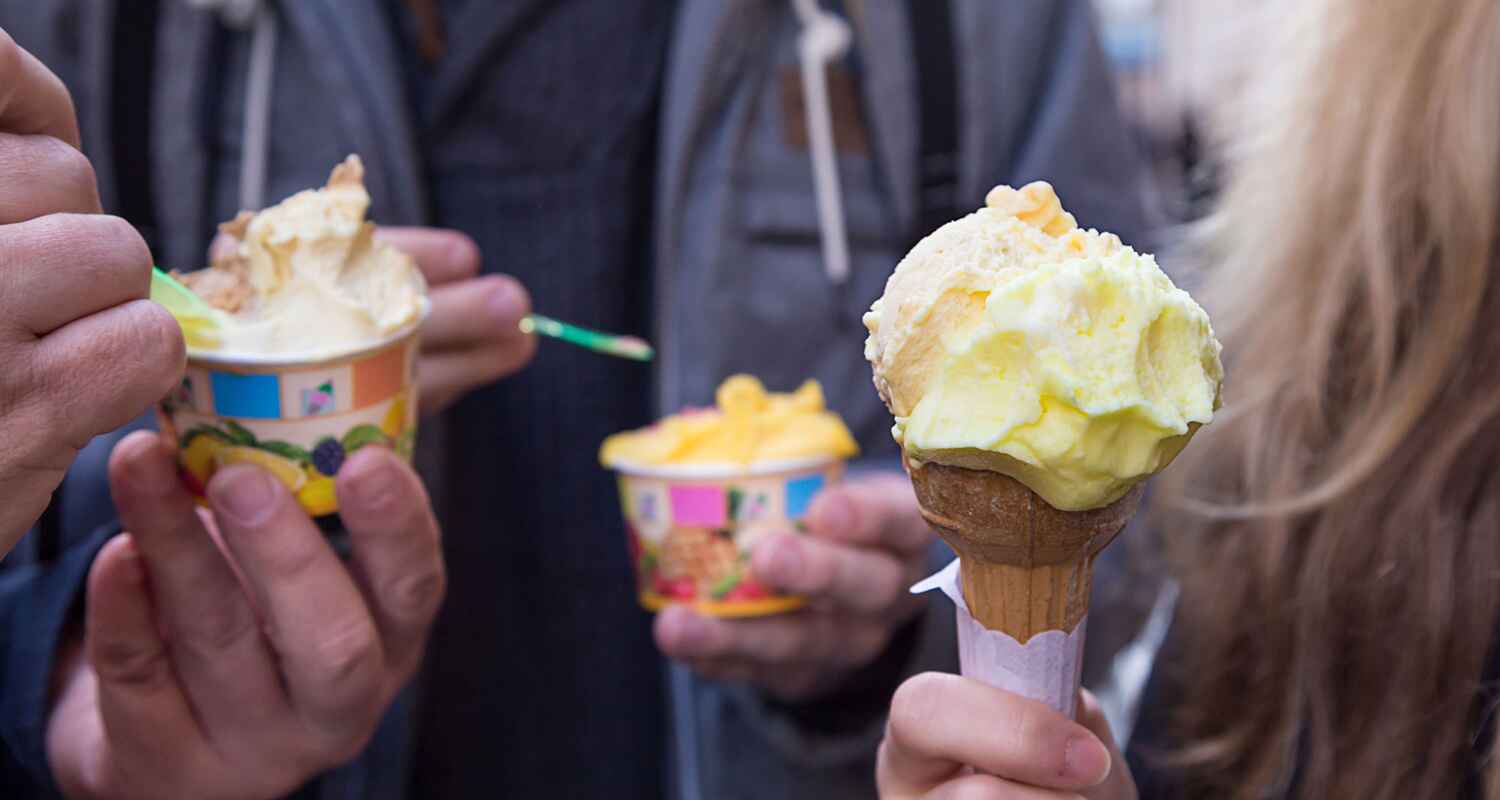
Audrey Hepburn’s Princess Ann has escaped her royal handlers and is eating gelato on the Spanish Steps. She throws away the cone when the gelato runs out, because why would a princess know you eat the cone too?
Every element is doing double duty. The gelato is freedom, unscheduled, unladylike, entirely her own. The wasted cone is both a joke and a character note: she has never learned the practical pleasures of ordinary life. It is the moment when the princess becomes a person, and it made Rome’s Spanish Steps one of the world’s most visited tourist sites in the process.
It’s a Wonderful Life (1946): Love at the Soda Fountain
Young George Bailey is serving behind the counter when Mary leans over and whispers into his deaf ear that she loves him. The ice cream is almost incidental, which is the point. It is ordinary life as the container for extraordinary feeling. George adds coconut to Mary’s chocolate because he likes it too, which is such an accurate small act of romantic overreach that it has delighted audiences for eighty years.
The Shining (1980): Ice Cream as a False Promise
Dick Hallorann offers young Danny a scoop: “How’d you like some ice cream, Doc?”, while communicating with him telepathically about the darkness of the Overlook Hotel. The ice cream is deliberate misdirection: it signals safety and the normal world of grown-ups offering children treats. Kubrick uses that comfort to make the scene more disturbing, not less.
Forrest Gump (1994): Character in Eight Seconds
Forrest brings Lieutenant Dan an ice cream cone while they recover in hospital. Dan dumps it into a bedpan. Two characters, perfectly defined.
Forrest’s uncomplicated desire to comfort someone he loves. Dan’s raw refusal of comfort itself. This is what great screenwriting looks like: an ordinary object carrying the full weight of a human dynamic.
The Break-Up Tub: Ice Cream as Emotional Shorthand
At some point in the 1980s and 1990s, popular culture settled on a particular image: a person alone, wrapped in a blanket, eating ice cream straight from the container. This became the universal shorthand for heartbreak. Bridget Jones and her Ben & Jerry’s. Various characters in romantic comedies reaching for the freezer after a romantic disaster.
The trope works because it captures something true. Ice cream is sweet but cold, comforting but temporary, and eating it from the container (skipping the formality of a bowl) is a small collapse of standards that grief briefly permits.
The shorthand has since become sophisticated enough to be played with: Friends got reliable laughs by handing the tub to Chandler instead, and when a character is devastated and does not reach for the ice cream, that absence becomes just as meaningful.
The Ice Cream Van: Nostalgia and Its Dark Inversion

The ice cream van occupies a specific place in the cultural imagination, particularly in Britain, where the tinny jingle of a Mr Whippy truck is one of the most reliable triggers of childhood nostalgia in existence.
Edgar Wright leaned into this with his “Cornetto trilogy.” Each film’s flavour carries symbolic meaning, and the recurring motif works precisely because an ice cream cone in a horror-comedy is instantly, pleasingly incongruous.
The dark inversion of the ice cream truck, something that signals innocent pleasure being turned into something menacing, has become a well-worn horror trope. John Carpenter’s Assault on Precinct 13 uses an ice cream vendor for one of its most shocking moments. The point is always the same: violating something we associate with childhood safety produces a specific kind of dread that nothing else quite replicates.
What Ice Cream Tells You About a Character
Directors and writers have learned that ice cream is an efficient character shorthand. Sharing it signals openness to connection.
Refusing it, like Lieutenant Dan, signals emotional withdrawal.
Eating it alone says something different from eating it with someone you love. Flavour choices, vanilla versus something elaborate and unusual, sketch a personality in seconds.
Once you notice these patterns, they are very hard to unsee.
Scoops of Meaning
The next time you order a scoop, or pull a tub from the freezer, or hear the distant sound of an ice cream van on a summer afternoon, you are participating in a cultural ritual that storytellers have been examining for over a century.
Ice cream works in fiction because it works in life. It is the taste of childhood and the comfort of the present moment. It melts, which makes every scoop worth savouring.
Wallace Stevens had it right. The only emperor is the emperor of ice cream.
Ready to serve your own iconic scoop? Browse our full range of ice cream packaging, toppings and sauces and ingredients and discover everything you need to make every serving memorable.


